

Week 9: July 30th - August 8th
Hello SSGN Team!
It’s a beautiful Monday here in Week 9. Our breeding season is winding down, with many colonies seeing changes in activity level. This brings to mind a few important topics to consider as we survey our way to the end of our breeding season.
Fledglings
We have had a few fledgling sightings this last week, so let’s talk about how to differentiate these new guys from the adults. Fledgling and juvenile ID can be tricky, especially when adults begin to molt into non-breeding plumage and take on a mottled appearance, so here are some things to look for:
Dark forehead, eye line, lore (area between the eye and beak), and crown. This makes the upper portion of the head appear more defined and darker than adults molting into non-breeding plumage.
White or “sooty” chin and throat
Mantle of bird (back) and proximal portion of wings are darker and underparts lighter or white.
Lack of defined, white wing patch, instead appearing more barred with brown or mottled.
Dark feathers appear more brown than black
Feet that are dark gray vs. bright red/orange
Other things to consider:
At this time of year, most PIGU are still in breeding plumage, so if you see a bird matching the description above, there is a high probability it is a fledgling.
Fledglings are usually spotted floating around on their own rather than socializing within their colony.
Fledglings are generally flightless for the first few weeks out of the nest. Meaning, they shouldn’t fly away or fly very
far.Adults retain their white wing bar year round, even while molting.
Thank you to Lee and Govinda for their input on fledgling ID and the Cornell, Birds of the World entry on Pigeon Guillemot plumage.
Here are some fledgling photos to help with your identification:
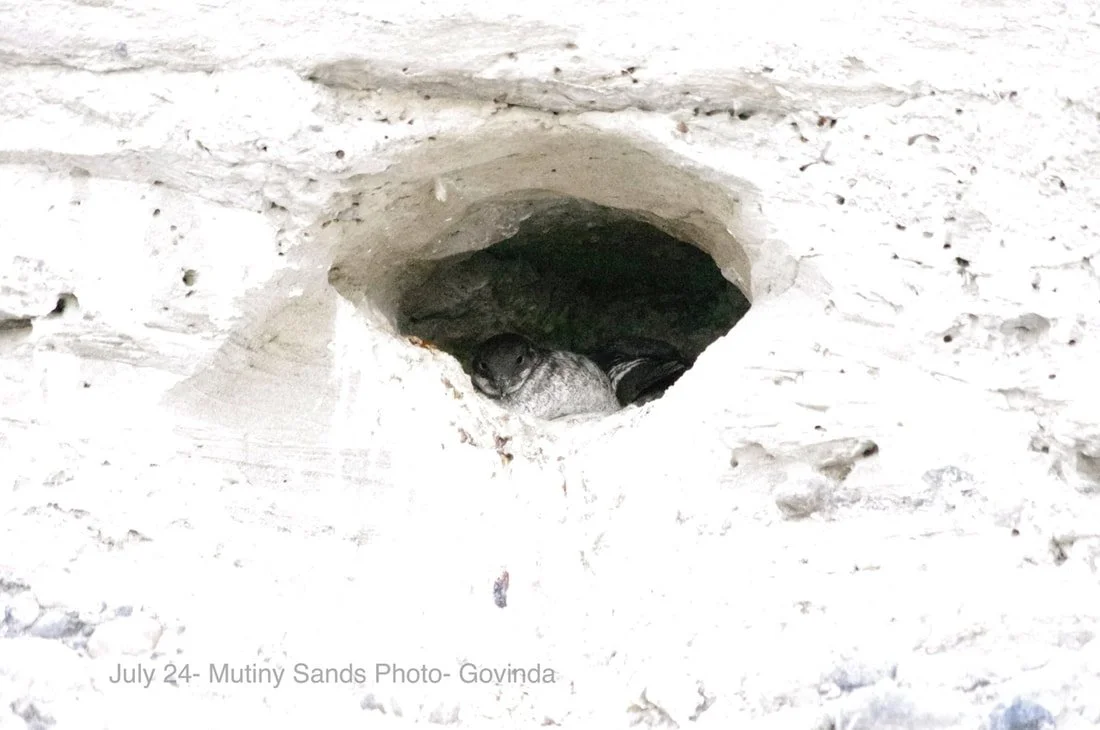
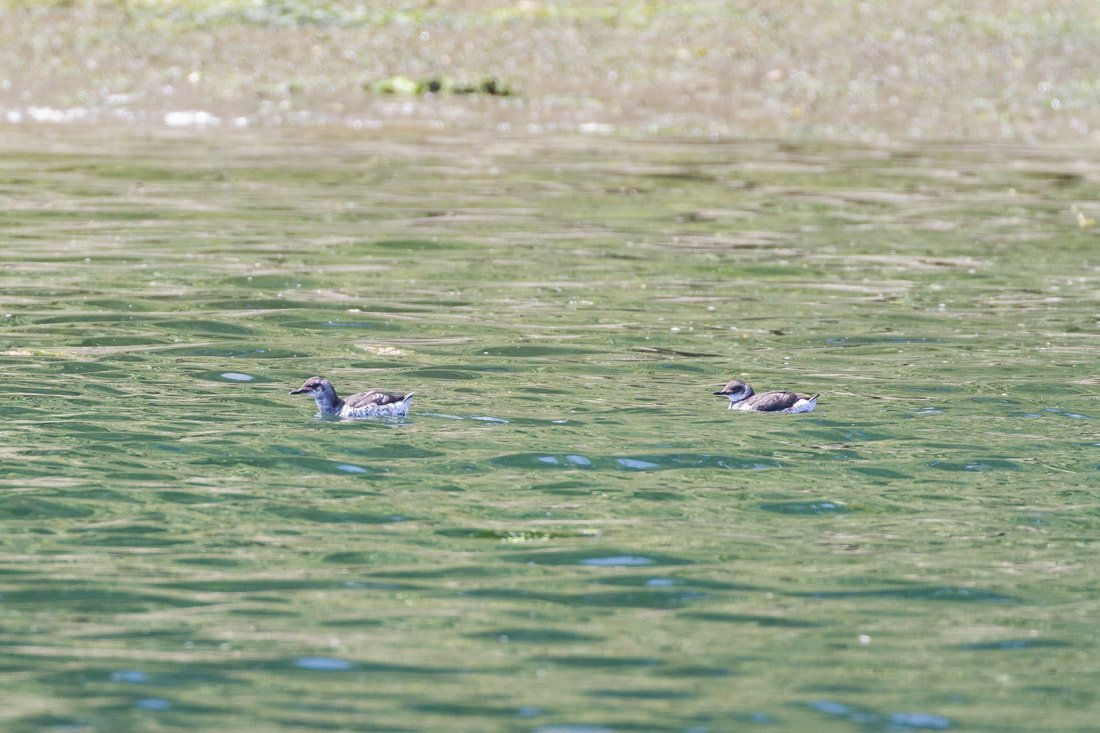
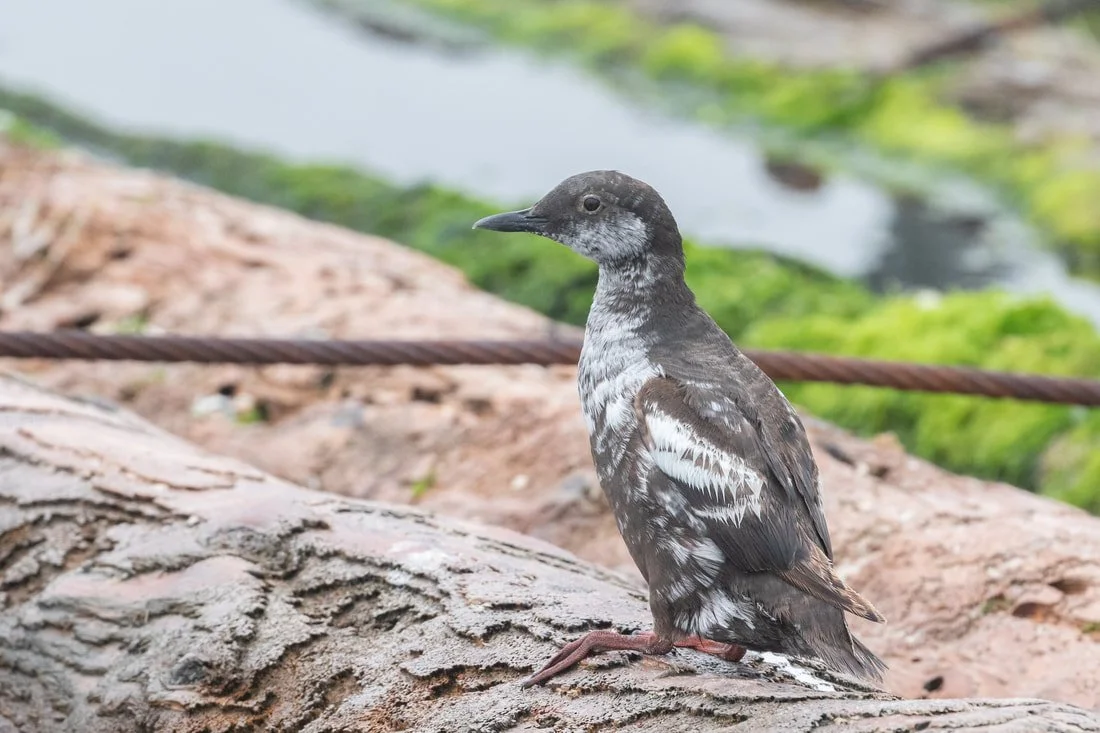
** Edit: After receiving some thoughtful correspondence from Lee and having additional thoughts of my own on Fledgling ID, I should put in a disclaimer regarding our ability to identify fledglings with certainty. The plumage description above came from an effort to summarize in simple terms the Cornell Birds of the World PIGU entry on plumage and from our own observations of birds we *think* to be fledglings. I say best effort because I am not an ornithologist or expert. The photos I shared are also of birds assumed to be fledglings because of the timing of when they were seen and the differences observed in size and coloration. Without actually seeing the birds fledge it is not possible to say they are such with 100% certainty. So please take these descriptions as loose guides and not absolutes.
Another difficulty with identification is in having the ability to discriminate between fledglings and juveniles. At this time, we do not have a definitive way to differentiate between the two. PIGU plumage through the fledgling, juvenile, and adult molting stages is complicated, and we do not have concrete descriptions to help us distinguish the subtle differences between them at this time.
I would like to add a link to a video on our website taken by Govinda Holtby. This is the only actual photo documentation SSGN has of a fledgling leaving its burrow. This may be the most helpful footage that we have in identifying fledglings.
PIGU Activity
Many folks are reporting interesting changes in PIGU behavior, such as increased ledge sitting and repeated flights to the bluff, without fish deliveries. I like to call this circus behavior. We aren’t exactly sure what this means, but it seems to follow 4-5 weeks of prey deliveries and comes shortly prior to a sudden fall in activity. There is some speculation that this activity is meant to coax chicks to fledge, but again, this is our own musing. Have any of you witnessed this seemingly bizarre behavior?
Some have also witnessed continued sparring, courting, and water game behavior. I was asked if it might be possible for them to copulate this late in the season, which I did not think likely. On Friday, however, one of our boat captains observed two PIGU mating on a buoy! Whether or not that will result in a successful reproduction cycle is unclear, but it proves that some things are still a mystery!
Closing a Colony Down for the Season
With week 9 here, some colonies will be entering the last two weeks of the breeding survey. Our protocol states that we must observe each colony for a minimum of 10 consecutive weeks, at which point, we may close a colony if we have not recorded activity for two weeks prior to week 10. If we have not had two weeks with no activity by week 10, then we continue to survey until we do. Surveyors should consult their coordinators to confirm that it is okay to close a colony.
Activity includes:
Burrow visits and ledge sitting
Birds holding fish on the water, even without delivery
Birds still associating with, congregating, and socializing at the colony
Exceptions can be made, at the discretion of regional coordinators, if there has been no activity and no or very few birds recorded at a colony all season. We don’t want to make surveyors feel as if they are stuck at a site with no hope for activity. If you are unsure if a colony fits into this category, feel free to reach out, and we can help you make that decision.